
RAG vs Fine-Tuning: When to Use Which
A first-principles breakdown of when retrieval-augmented generation earns its complexity and when a fine-tuned model is the cleaner bet. No fluff.
by Ankor
The question comes up in every AI strategy engagement we’ve had in the last 18 months: should we build a RAG system or fine-tune a model?
The answer is almost never obvious, and the Internet is full of bad frameworks that make it sound simple. It isn’t. This post is what we tell CTOs and VP Engs when they ask us — the actual decision tree, not the surface-level pros/cons list.
The Core Misunderstanding
Most teams approach this as a binary choice between two techniques. It isn’t. RAG and fine-tuning solve fundamentally different problems:
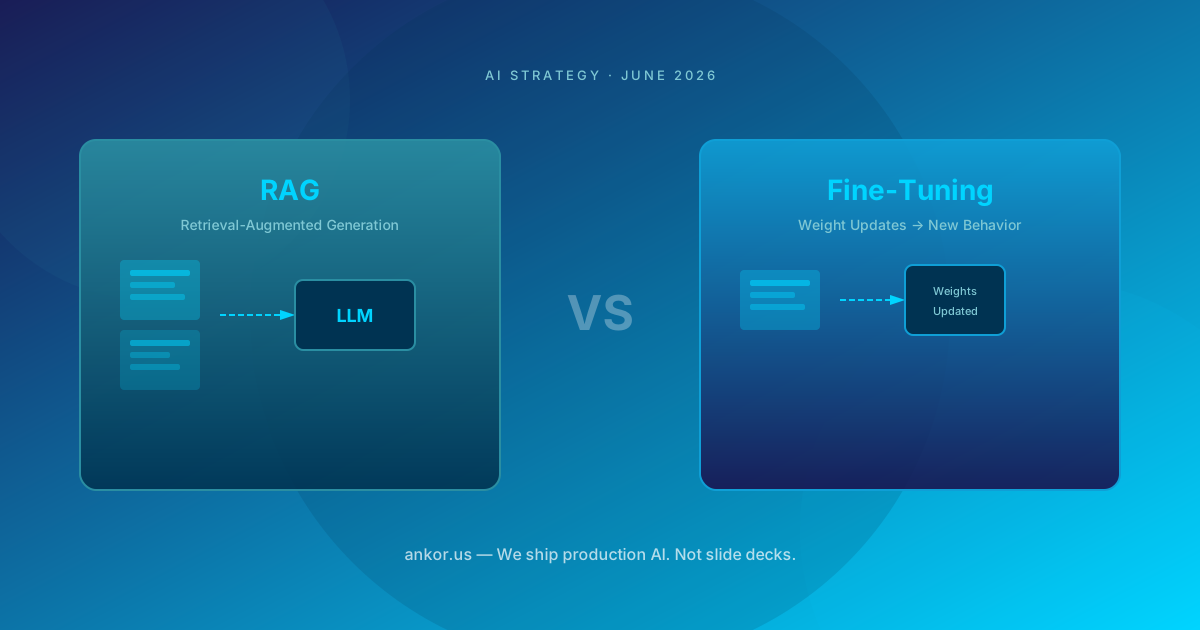
- RAG adds knowledge to a model’s output by retrieving documents at inference time and injecting them into the context.
- Fine-tuning changes the model’s behavior — how it reasons, formats, and responds — by updating its weights.
The confusion comes because both appear to solve the same symptom: the model doesn’t know enough. But the root causes are different, and solving the wrong root cause is expensive.
When RAG Is the Right Call
RAG earns its complexity in three situations:
1. Knowledge changes frequently
If your data updates daily or hourly — inventory, pricing, regulatory documents, internal policies — fine-tuning is a maintenance nightmare. You’d need to retrain every time a fact changes. RAG lets you update a document store without touching the model.
This is why we built Compass with a RAG-first architecture. Career recommendation data shifts with market conditions; retraining a model every week isn’t feasible.
2. You need verifiability and audit trails
When a model responds with a fact from a document, you can show exactly which document it came from. That’s harder with fine-tuning — the knowledge is baked into weights, not traceable to a source. For regulated industries or internal compliance use cases, this matters.
3. You have a large knowledge base but limited training data
If you have 50,000 documents worth of domain knowledge but only 200 labeled examples of the behavior you want, fine-tuning won’t have enough signal. RAG lets you leverage all50,000 documents without a single labeled example.
When Fine-Tuning Is the Right Call
Fine-tuning wins when the problem is behavioral, not informational:
1. The model needs to reason in a specific way
If you want a model to follow a complex chain-of-thought, output in a specific format, or apply domain-specific logic that can’t be prompted reliably, fine-tuning is the tool. No amount of context injection teaches a model to think differently — that’s a weight change.
2. Latency and cost at scale
RAG adds inference-time overhead: the retrieval step, the context window, the longer prompt. At high request volumes, this compounds. A fine-tuned model that doesn’t need injected context is faster and cheaper per query. We saw this with XAM — with 80+ organizations on the platform, every unnecessary token in the prompt was money left on the table.
3. Consistent brand voice and response style
If you need the model to sound like your product, follow a specific dialogue structure, or handle edge cases in a consistent way, fine-tuning is the cleaner solution. Prompt engineering can do this to a point, but it’s brittle — one prompt update can break things in production.
4. You have the data to do it well
Fine-tuning requires high-quality, curated training examples. Not thousands of mediocre examples — hundreds of excellent ones. If your internal team can’t produce 200-500 carefully crafted examples of the exact behavior you want, fine-tuning will disappoint.
The Decision Tree
Here’s the actual framework we use internally:
Is the problem informational (model doesn't know facts)?
 └── YES → Is the knowledge dynamic or large?
 ├── YES → RAG
        └── NO → Do you have 200+ high-quality training examples?
              ├── YES → Fine-tuning
              └── NO → RAG
 └── NO → Is the problem behavioral (model reasons/formats wrong)?
        ├── YES → Can you afford 200+ curated training examples?
        │     ├── YES → Fine-tuning
        │     └── NO → Prompt engineering + eval-driven iteration
        └── NO → You probably don't need either yet.
Notice that prompt engineering + eval-driven iteration is a valid path. Many teams jump to fine-tuning when they haven’t exhausted prompt engineering. We covered this in harness engineering — build the test rig before the model.
The Hybrid Path (And When to Take It)
Sometimes teams end up with both: a fine-tuned model that handles reasoning, plus RAG that provides dynamic knowledge. This is legitimate but expensive. You now have two systems to maintain, two failure modes, and twice the operational complexity.
The hybrid path makes sense when:
- You have a large, dynamic knowledge base and need specialized reasoning behavior
- You have the engineering bandwidth to maintain both systems
- You’ve exhausted what a well-prompted base model can do
We’ve shipped hybrid systems for clients where the knowledge base was too large to fine-tune and the reasoning requirements were too specific for generic prompts. It works — but it’s not the first call.
What Most Articles Get Wrong
The typical “RAG vs fine-tuning” article gives you a pros/cons table. Here’s what they miss:
| Factor | RAG | Fine-tuning |
|---|---|---|
| Knowledge updates | Real-time | Requires retraining |
| Traceability | High (source documents) | Low (weights) |
| Latency | Higher (retrieval step) | Lower (no context injection) |
| Cost at scale | Higher (per-query retrieval) | Lower (fixed model cost) |
| Behavioral control | Limited | Strong |
| Training data required | None | 200-500 curated examples |
The table looks clean. But it doesn’t tell you that you’ll probably need both eventually, or that the real question is whether you’re solving an informational or behavioral problem in the first place.
Actionable Next Steps
If you’re evaluating this for your organization:
- Run the decision tree above before committing to either path. Most teams we’ve worked with assumed they needed fine-tuning when RAG was the right first step.
- Audit your retrieval first if you go RAG. Use recall and precision metrics on your embedding search. If retrieval is broken, fine-tuning won’t save you. (We wrote about RAG failure modes in RAG Retrieval Failures.)
- Start with prompt engineering + evals before fine-tuning. Document your eval set before you write a single training example. You need this to know if fine-tuning actually helped.
- Budget for maintenance — both systems require ongoing work. RAG needs embedding updates and document freshness checks. Fine-tuning needs eval regression runs every time you change the model or requirements.
The right choice is the one that solves your actual problem with the least ongoing operational burden. That depends on your data, your team, and your scale — not a table in a blog post.
Need help deciding? Talk to us. We’ve shipped both RAG and fine-tuning systems for 190+ clients across industries. We can tell you which path makes sense for your stack.