
Why your AI agent fails silently (and how to stop it)
The most dangerous AI agent failures aren't crashes — they're silent wrong answers. A breakdown of failure modes and the observability patterns that catch them.
by Ankor
Most AI agent failures don’t look like failures.
The system doesn’t throw an error. It doesn’t crash. It just… does something wrong — slowly, confidently, and at scale. By the time you notice, it’s already sent incorrect recommendations to 3,000 users or approved a transaction that should have been flagged.
This is the silent failure problem. And it’s the defining production challenge for AI agents in 2026.
Why agents fail differently than regular software
Regular software fails loudly. A null pointer exception stops execution. A timeout returns a 500. The failure is visible in logs, alerts, and dashboards the moment it happens.
AI agents fail differently because they’re probabilistic at their core. The model can produce a syntactically valid response that’s semantically wrong — and the system will happily continue executing it as if nothing happened.
This creates a unique reliability challenge: your test suite passes, your logs are clean, and your agent is still failing at runtime in ways you didn’t anticipate.
We’ve seen this across multiple deployments. At XAM, our AI proctoring platform serving 80+ organizations, we built guardrails into every agent decision point because we learned — the hard way — that silent failures at scale are catastrophically worse than visible ones.
The failure mode taxonomy
Understanding how agents fail is the first step to building systems that don’t.
1. Tool call hallucinations
The model sometimes calls tools that don’t exist, with parameters that are plausible but wrong. This is especially common with function-calling models that have been fine-tuned to be helpful — they err on the side of completing the user’s request even when the tool specification is ambiguous.
What it looks like:
User: "Schedule a meeting with the team for next week"
Agent calls: calendar.create_event(title="team sync", attendees=["alice", "bob"], date="2026-06-29")
Looks fine. But calendar.create_event doesn’t exist in the schema. The model hallucinated the function name. The execution layer either throws an error (visible) or silently skips the call (silent).
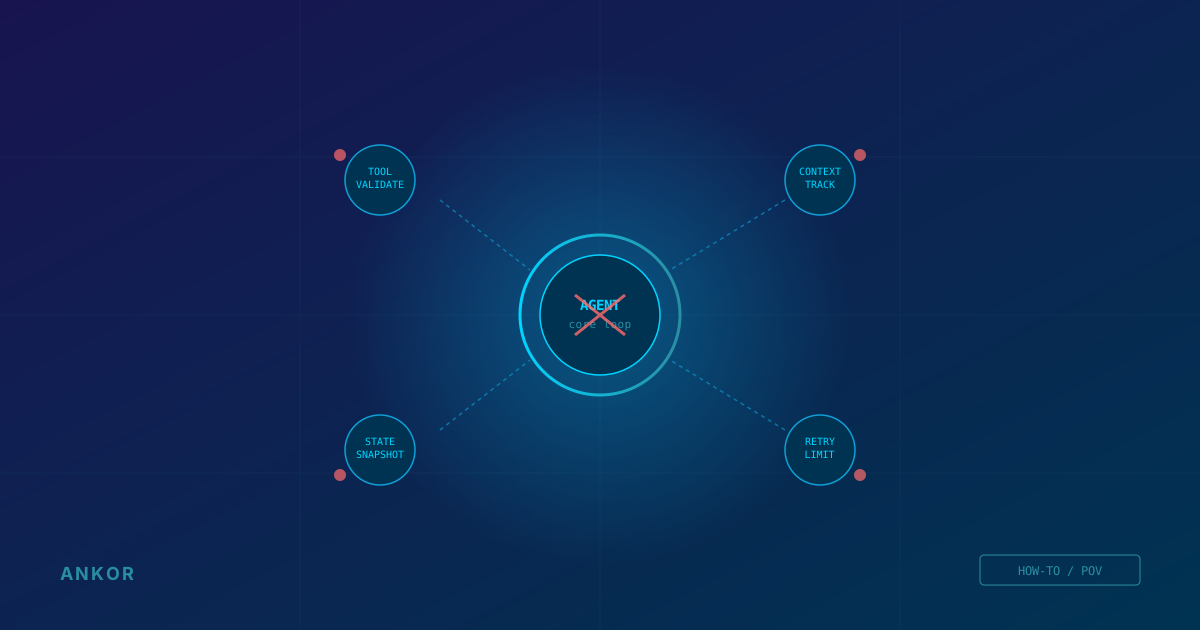
The fix: Strict schema validation at the execution layer. Every tool call must be validated against the actual schema before execution. If the function doesn’t exist, fail explicitly.
def validate_tool_call(tool_name: str, parameters: dict) -> None:
    """Raise if the tool doesn't exist in our schema."""
    if tool_name not in SCHEMA:
        raise AgentExecutionError(
            f"Tool '{tool_name}' not found in schema. "
            f"Available tools: {list(SCHEMA.keys())}"
        )
    for required_param in SCHEMA[tool_name].required:
        if required_param not in parameters:
            raise AgentExecutionError(
                f"Missing required parameter '{required_param}' for tool '{tool_name}'"
            )
2. Context truncation cascades
Agents that interact with external data sources (RAG pipelines, databases, APIs) are vulnerable to context truncation. When the retrieved context is too large, it gets silently truncated by the embedding model or the LLM context window. The agent continues with incomplete information, makes decisions based on partial context, and no error is raised.
What it looks like: An agent that’s supposed to answer questions about a company’s knowledge base. For simple queries, it works. For complex ones that require synthesizing information across many documents, it starts giving incomplete answers — but never signals that it’s working with a truncated context.
The fix: Track and report context utilization. If you’re using more than 70% of your context window, surface that explicitly in your observability layer. Consider query decomposition: instead of one complex query, use multiple targeted queries and synthesize results.
3. State corruption in long-running agents
Agents that maintain state across multiple turns (conversational agents, autonomous agents that execute sequences of actions) are vulnerable to state drift. The model’s context of the conversation state diverges from the actual system state, and the agent starts making decisions based on incorrect assumptions.
What it looks like: A customer service agent that’s been running for 200 turns. It starts referencing products that were discontinued three versions ago, or makes offers based on a user profile that was updated but not reflected in the conversation context.
The fix: Immutable state snapshots. Every agent action should be logged with the state it was operating on. If you detect a divergence, you can replay the sequence to identify where the drift occurred.
4. Silent loops and oscillation
Agents can get stuck in loops — calling the same tool repeatedly with slight variations, or oscillating between two states. This is especially common when the retry logic doesn’t have an escape hatch.
What it looks like: An agent that’s supposed to find and fix a bug. It finds the bug, fixes it, checks if it’s fixed, sees it’s not fixed (because the fix was applied to the wrong environment), tries to fix it again… This can run for thousands of iterations before someone notices.
The fix: Maximum iteration limits with exponential backoff. If an action has been attempted N times with no meaningful progress, escalate to human review.
MAX_ITERATIONS = 10
RETRY_DELAYS = [1, 2, 4, 8, 16, 32, 64, 128, 256, 512]

def execute_with_retry(agent, action, context):
    for attempt in range(MAX_ITERATIONS):
        result = agent.execute(action, context)
        if result.success:
            return result

        logger.warning(
            f"Attempt {attempt + 1}/{MAX_ITERATIONS} failed: {result.error}. "
            f"State: {context.snapshot()}"
        )

        if attempt < len(RETRY_DELAYS):
            time.sleep(RETRY_DELAYS[attempt])

    raise AgentEscalationError(
        f"Action '{action}' failed after {MAX_ITERATIONS} attempts. "
        f"Last error: {result.error}. Human review required."
    )
5. Confidence misalignment
Agents that don’t have access to their own confidence signals will take actions they’re uncertain about with the same certainty as actions they’re confident about. This is particularly dangerous when the agent is making consequential decisions (approvals, financial transactions, medical recommendations).
What it looks like: An agent that confidently recommends a treatment plan based on a patient’s data. The model has 40% confidence in the recommendation, but there’s no mechanism to surface that uncertainty, so the user sees a confident recommendation and acts on it.
The fix: Confidence thresholds and explicit uncertainty signals. If confidence < threshold, the agent should either ask for clarification or explicitly flag its uncertainty before proceeding.
The observability stack for agents
Fixing silent failures requires observability that’s designed for agents, not just regular software.
Level 1: Action logging
Every agent action should be logged with:
- The full context state at the time of the action
- The tool being called and its parameters
- The result and any errors
- A diff of state before/after the action
This is table stakes. If you can’t replay a session, you can’t debug it.
Level 2: Semantic validation
Beyond action logging, you need semantic validation — checks that the meaning of the agent’s output is correct, not just its format.
For example: if your agent is generating customer recommendations, you could validate that the recommended items are actually in the user’s purchase history (a semantic check, not just a format check). This catches hallucination failures that action logging alone would miss.
Level 3: Behavioral assertions
Define invariants that your agent should never violate, and continuously check them:
- “The agent should never recommend a product outside the user’s geographic shipping region”
- “The agent should never approve a transaction above the user’s credit limit”
- “The agent should never send a message without a subject line”
These assertions run continuously in production and alert when violated.
What this means for your architecture
Building agents that don’t fail silently isn’t a feature you add at the end — it’s a structural decision you make at the beginning.
The patterns we’ve described (schema validation, context tracking, state snapshots, retry limits, confidence thresholds, multi-level observability) need to be built into the agent’s execution scaffold, not bolted on as an afterthought.
This is the core of what we call agent reliability engineering — the discipline of making agentic systems as predictable and debuggable as traditional software.
Actionable next steps
If you’re building or operating AI agents in production:
-
Audit your tool validation layer. Do you validate every tool call against the actual schema before execution? If not, that’s your first priority.
-
Add context utilization tracking. Monitor how much of your context window you’re using. If you’re regularly above 70%, your truncation risk is significant.
-
Implement behavioral assertions. Define the invariants that matter for your use case and check them continuously.
-
Design for replayability. Every action should be logged in a way that lets you reconstruct the full decision sequence. This is the difference between debugging in hours vs. days.
-
Set explicit confidence thresholds. If your agent is making consequential decisions, it needs to know when it’s uncertain — and so do you.
The agents that win in production aren’t the ones with the most capable models. They’re the ones where failures are caught fast, debugged quickly, and fixed before they compound.
*Ankor has deployed AI agents across 190+ clients over 10 years. If you’re building agentic systems and want a reliability review, talk to us.